Quick answer
Our overall pick for a manual lawn aerator is the AHXPOCF 12-Spike Aerator for its deep, thick spikes that penetrate hard soil. Other picks are better for small areas, core aeration, or users seeking an adjustable, knee-friendly design.
Aerating your lawn is a key step in creating a healthier, more resilient yard that supports pollinators. By relieving soil compaction, you help air, water, and nutrients reach grass roots more effectively, which can reduce the need for excessive watering and chemical inputs. This roundup of the best lawn aerators focuses on manual tools, comparing their listed features and specifications to help you find the right fit for your bee-friendly lawn care routine.
Our picks at a glance

Pros
- Deep 4.53-inch steel spikes for hard soil
- Reinforced bolt-on structure for durability
- Compact base concentrates stepping force
Cons
- Manual operation requires physical effort
- The listing does not mention a handle for upright use
- Spike design does not remove soil cores

Pros
- 15 spikes cover more area per step
- Long handle with T-grip reduces bending
- Detachable for easy storage
Cons
- Shorter 2.8-inch spikes
- Not for heavy clay or rocky soil
- Manual operation

Pros
- Extracts soil plugs for core aeration
- Patented rotary coring design
- Includes transport wheels
Cons
- Large size (60 inches long)
- Manual push operation requires effort
- The listing does not mention adjustable handle height
Pros
- Adjustable height (43.3-48.5 inches)
- Hollow tines extract soil cores
- Flow-through ejection reduces clogging
Cons
- Only four tines
- Manual step-down operation
- Stainless steel construction may be heavier
Pros
- Hollow tines extract soil cores
- Replaceable tines
- Side-ejection design reduces clogging
Cons
- Only three tines (can be reduced to two)
- Manual operation
- The listing does not mention an adjustable handle

Pros
- Double spring design for automatic cleaning
- Adjustable height (32-35 inches)
- 15 iron spikes
Cons
- Shorter 1.74-inch spikes
- Spike design does not remove soil cores
- The listing does not specify handle grip type
How we chose
Our editors compared manufacturer listings and specifications on Amazon as of October 2026. We did not test these products hands-on. Our selections are based on analyzing the listed features, construction materials, spike or tine design, and intended use cases to identify tools suited for different lawn care needs.
Best Lawn Aerators for Healthy Soil: our picks in detail
1. Best overall lawn aerator: AHXPOCF 12-Spike Manual Aerator
The AHXPOCF manual lawn aerator is built with 12 steel spikes that are 4.53 inches deep and 6.5mm thick, designed to penetrate compacted soil. Its compact base is intended to concentrate stepping force for more effective penetration. The tool features a reinforced bolt-on structure instead of welded connections, which the listing states helps reduce the risk of cracking.
Assembly is noted to be easy with the included installation wrench, and the bolt-on design is said to make maintenance easier. The overall dimensions are 16.33 inches in height, 10.23 inches in length, and 5.7 inches in width.
Best for: This is the best lawn aerator for penetrating hard, compacted soil with its extra-long, thick steel spikes.
Pros
- Deep 4.53-inch steel spikes for hard soil
- Reinforced bolt-on structure for durability
- Compact base concentrates stepping force
Cons
- Manual operation requires physical effort
- The listing does not mention a handle for upright use
- Spike design does not remove soil cores
2. Best lawn aerator for small areas: Walensee 15-Spike Aerator
The Walensee manual lawn aerator has 15 iron spikes, each about 2.8 inches long, arranged in a three-row layout for more coverage per step. It features a 34.6-inch handle with a cushioned T-grip and a foot pedal, designed to reduce bending. The listing states it is ideal for small-area lawn care, spot aeration, and narrow spaces.
Made with heavy-duty iron and a powder-coated finish, it has a detachable design for easy storage. The listing advises watering the lawn first to soften hard or dry soil and notes it is not recommended for heavy clay soil, rocky ground, or large-scale jobs.
Best for: This is the best lawn aerator for small lawns, spot treatments, and narrow spaces where a larger tool wouldn’t fit.
Pros
- 15 spikes cover more area per step
- Long handle with T-grip reduces bending
- Detachable for easy storage
Cons
- Shorter 2.8-inch spikes
- Not for heavy clay or rocky soil
- Manual operation
3. Best lawn aerator for core aeration: K.D STONEDGE Rolling Core Aerator
The K.D STONEDGE Rolling Lawn Aerator is a manual push tool that uses a patented rotary coring design to punch holes and extract soil plugs. The listing states it helps improve air, water, and nutrient absorption by pulling plugs to relieve soil compaction. It is built with a heavy-duty construction and features transport wheels.
With a scientifically balanced weight design, it is intended for efficient plug pulling in small to medium lawns. The tool’s dimensions are 60 inches in length, 17 inches in width, and 11 inches in height.
Best for: This is the best lawn aerator for gardeners who want to perform core aeration by removing soil plugs from their lawn.
Pros
- Extracts soil plugs for core aeration
- Patented rotary coring design
- Includes transport wheels
Cons
- Large size (60 inches long)
- Manual push operation requires effort
- The listing does not mention adjustable handle height
4. Best knee-friendly lawn aerator: Josmimic Knee-Friendly Core Aerator
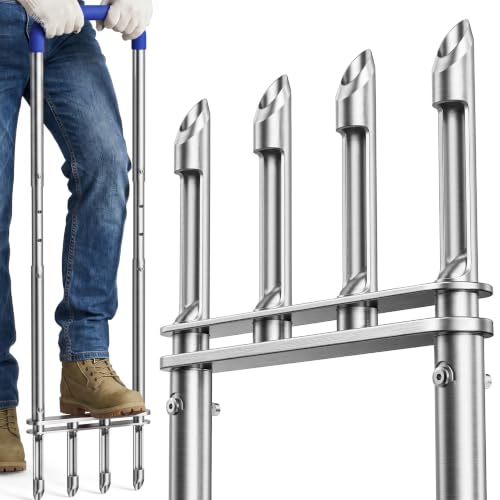
The Josmimic manual lawn aerator has an adjustable height from 43.3 to 48.5 inches and an open knee area designed for a more comfortable, upright working position. It uses four hollow tines to extract small soil cores, with a flow-through ejection system that sends soil out the side to reduce clogging.
Constructed from brushed silver stainless steel, it features a wide dual-foot platform for applying even pressure. The tool weighs 5.5 pounds and is noted for quick assembly, making it suitable for small lawns, edges, and isolated hard-soil spots.
Best for: This is the best lawn aerator for users seeking an adjustable, upright design that is easier on the back and knees.
Pros
- Adjustable height (43.3-48.5 inches)
- Hollow tines extract soil cores
- Flow-through ejection reduces clogging
Cons
- Only four tines
- Manual step-down operation
- Stainless steel construction may be heavier
5. Best lawn aerator with replaceable tines: Xuperace Core Aerator
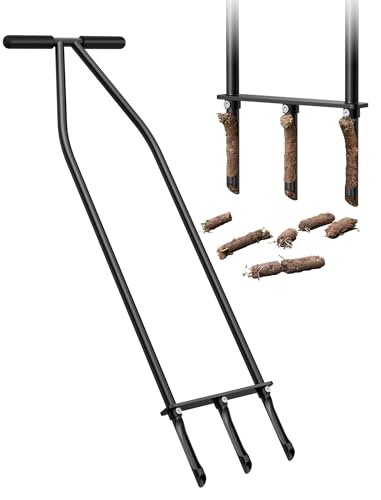
The Xuperace lawn aerator is a core aerator with three hollow, alloy steel tines that pull plugs of soil from the ground. It features a patented design where soil plugs eject out the side to solve clogging problems. The tool has a knee-friendly design with a footplate that allows free knee movement to use less force.
The hollow tines are replaceable and connected to the frame with screws. The listing suggests the tool works best on moist grass and notes that the middle tine can be removed for easier work in harder ground. The frame is integrally formed for durability.
Best for: This is the best lawn aerator for those who want a core aerator with replaceable tines and a clog-resistant design.
Pros
- Hollow tines extract soil cores
- Replaceable tines
- Side-ejection design reduces clogging
Cons
- Only three tines (can be reduced to two)
- Manual operation
- The listing does not mention an adjustable handle
6. Best lawn aerator with automatic cleaning: RIFPOD Adjustable Spike Aerator
The RIFPOD Lawn Aerator features a patent-pending double spring design intended to automatically remove soil and dried leaves from its 15 iron spikes after aeration. It has an adjustable height ranging from 32 to 35 inches. The spikes are 1.74 inches long and made of thickened iron with a sprayed and welded finish for rust resistance.
The listing states it is easy to install with screws, washers, and a small wrench. It is built with a reinforced casing for durability under demanding conditions.
Best for: This is the best lawn aerator for users who want a spike aerator with a self-cleaning mechanism and adjustable height.
Pros
- Double spring design for automatic cleaning
- Adjustable height (32-35 inches)
- 15 iron spikes
Cons
- Shorter 1.74-inch spikes
- Spike design does not remove soil cores
- The listing does not specify handle grip type
Our picks for the best lawn aerators at a glance
| Product | Type | Spikes/Tines | Key Feature | Height |
|---|---|---|---|---|
| AHXPOCF 12-Spike | Spike | 12 steel spikes | 4.53-inch deep spikes | 16.33 in |
| Walensee 15-Spike | Spike | 15 iron spikes | Long handle, small areas | Not listed |
| K.D STONEDGE Rolling | Core | Not listed | Pulls soil plugs, has wheels | 11.0 in |
| Josmimic Knee-Friendly | Core | 4 hollow tines | Adjustable height (43.3-48.5 in) | 48.5 in |
| Xuperace Core Aerator | Core | 3 hollow tines | Replaceable tines | 42.0 in |
| RIFPOD Adjustable | Spike | 15 iron spikes | Automatic cleaning springs | Adjustable 32-35 in |
How to choose a manual lawn aerator
Selecting the right aerator depends on your soil type, lawn size, and physical comfort. The two main types are spike aerators and core (or plug) aerators. Spike aerators use solid tines to punch holes in the soil, which can help with mild compaction. Core aerators remove small plugs of soil, creating deeper channels for air and water—this is often considered more effective for severely compacted ground and is a great practice before overseeding a bee-friendly lawn.
Consider the construction and ease of use. Look for durable materials like steel or coated iron that can withstand repeated use. An adjustable handle or an upright, knee-friendly design can make the job much more comfortable, especially for larger yards. Also, check how the tool manages the removed soil; some core aerators have side-ejection channels to prevent clogging.
What to look for
- Spike vs. Core: Spike aerators are simpler, but core aerators that remove soil plugs provide deeper relief for compacted soil.
- Build Quality: Look for reinforced joints, thick spikes/tines, and rust-resistant finishes for longevity.
- Ergonomics: Adjustable handles, wide foot platforms, and upright designs reduce strain on your back and knees.
- Lawn Size Match: A tool with many spikes or a rolling design may cover area faster, while compact tools are better for small or tricky spots.
Remember, aeration is a key part of integrated lawn care that supports soil life and reduces runoff. For more on creating a habitat that supports pollinators, visit resources like the Xerces Society and the EPA’s principles of Integrated Pest Management.
FAQ
What’s the difference between spike aeration and core aeration?
Spike aeration uses solid tines to poke holes in the soil, which can help break up mild surface compaction. Core aeration uses hollow tines to remove small plugs of soil, creating deeper, more open channels for air, water, and nutrients to reach grass roots. Many lawn care experts consider core aeration more effective for relieving severe soil compaction.
When is the best time to aerate my lawn?
The ideal time is during your grass’s peak growing season, which is typically early fall or spring for cool-season grasses and late spring to early summer for warm-season grasses. Aerating when the grass is actively growing helps it recover quickly and fill in the open holes.
Can I aerate a lawn that has a lot of clover or other broadleaf plants?
Yes, manual aerators can be used on lawns with clover and other flowering plants. In fact, aeration benefits the entire soil ecosystem. Reducing compaction helps all plants, including the clover that provides nectar for bees. It’s a healthy practice for a diverse, bee-friendly lawn.
How do I prepare my lawn for aeration?
For the best results, water your lawn thoroughly one or two days before aerating. Moist (but not soggy) soil allows the aerator tines to penetrate more easily and pull cleaner plugs. It’s also a good idea to clearly mark any sprinkler heads or shallow utility lines to avoid damaging them.
References
- Amazon product listings and manufacturer specifications (accessed October 2026)
- EPA – Integrated Pest Management (IPM) Principles
- Xerces Society – Pollinator Conservation