Quick answer
Our overall pick is the Perfect Plants Black Knight Butterfly Bush for its classic, fragrant dark purple blooms and adaptability across many zones. Other selections cater to gardeners needing compact plants for containers, specific flower colors, or starter plants for landscaping.
Butterfly bushes (Buddleia) are renowned for their long, fragrant flower spikes that are a magnet for butterflies, bees, and hummingbirds. Choosing the best butterfly bush plant for your garden depends on your climate, available space, and color preference. We’ve compared the manufacturer listings for 15 different options to help you select a shrub that will thrive and support pollinators in your landscape.
Quick picks
- Overall pick: Perfect Plants Black Knight Butterfly Bush (see on Amazon)
- Best compact red: Perfect Plants Li’l Raspberry Butterfly Bush (see on Amazon)
- Best cold-hardy dwarf: Perfect Plants Li’l Coconut Butterfly Bush (see on Amazon)
- Best proven blue dwarf: Pugster Blue® Butterfly Bush – Proven Winners (see on Amazon)
15 Best Butterfly Bush Plants for Pollinators compared
| # | Product | Best for | Mature Height | USDA Hardiness Zones | Flower Color |
|---|---|---|---|---|---|
| 1 | Perfect Plants Black Knight Butterfly Bush | Best overall butterfly bush plant | Up to 8 ft (per similar listing) | Zones 5-9 | Dark Purple |
| 2 | Perfect Plants Nanho Blue Butterfly Bush | Best for fragrant purple blooms in a mid-size shrub | 4-6 ft | Zones 5-9 | Purple |
| 3 | Perfect Plants Royal Red Butterfly Bush | Best tall shrub for hedges with reddish-purple flowers | 6-8 ft | Zones 5-9 | Reddish-Purple |
| 4 | TriStar Plants Black Knight Butterfly Bush | Best established 1-gallon plant for a classic purple bush | Up to 8 ft | Zones 5-9 | Purple (Black Knight) |
| 5 | TriStar Plants White Butterfly Bush | Best established 1-gallon plant for a white butterfly bush | Up to 8 ft | Zones 5-9 | White |
| 6 | Greenwood Nursery ‘Grand Cascade’ Butterfly Bush | Best for dramatic, long cascading flower spikes | 5-6 ft | Not listed | Purple |
| 7 | Perfect Plants Li’l Raspberry Butterfly Bush | Best compact butterfly bush with vivid red blooms | 2-3 ft | Zones 5-10 | Red |
| 8 | Perfect Plants Li’l Coconut Butterfly Bush | Best cold-hardy dwarf with creamy white flowers | 2-3 ft | Zones 5-10 | White |
| 9 | Miss Molly Butterfly Bush Dwarf | Best dwarf bush for vibrant pink and red blooms | Not listed | Not listed | Red Pink |
| 10 | Pugster Blue Dwarf Butterfly Bush | Best dwarf butterfly bush with large blue flower spikes | Not listed | Not listed | Blue |
| 11 | Lo & Behold ‘Blue Chip Jr.’ Dwarf Butterfly Bush | Best ultra-compact butterfly bush for very small spaces | 1.5-2.5 ft | Zones 5-9 | Blue-Purple |
| 12 | Pugster Blue® Butterfly Bush – Proven Winners | Best proven winner blue dwarf variety | 24-36 in | Zones 5-9 | Blue |
| 13 | Proven Winners Pugster Sorbet Butterfly Bush | Best compact bush with unique clear purple and light orange flowers | 1-2 ft | Zones 5-10 | Clear Purple-Light Orange |
| 14 | Red Butterfly Bush Live Starter Plant | Best red starter plant | Not listed | Not listed | Red |
| 15 | Raspberry Butterfly Bush Live Plant | Best bare-root starter for raspberry-pink blooms | Not listed | Zones 5-9 | Raspberry-Pink |
How we chose
Our editors compared the manufacturer-provided features and specifications from Amazon listings as of October 2026. We did not test or review these plants hands-on. Our selections are based on comparing stated attributes like mature size, hardiness zones, flower color, and specific features like compact growth or fragrance to match different gardener needs.
Best for classic, full-size butterfly bushes
These larger varieties offer traditional, fragrant blooms and can make a dramatic statement in borders or as a hedge.
1. Best overall butterfly bush plant: Perfect Plants Black Knight Butterfly Bush

Pros
- Fragrant, dark purple blooms
- Attracts bees, hummingbirds, and butterflies
- Heat and drought tolerant once established
Cons
- Deciduous; may die back in winter in cold zones
The Perfect Plants Black Knight Butterfly Bush is a classic choice, featuring honey-scented, dark purple flower spikes that bloom from summer to fall. It is listed as fast-growing and drought-tolerant once established, thriving in USDA zones 5-9. This deciduous shrub attracts bees, hummingbirds, and butterflies. The listing notes it may die back in winter in colder zones and regrow in spring.
Best for: Gardeners seeking a traditional, fragrant, and adaptable butterfly bush that attracts a wide range of pollinators.
2. Best for fragrant purple blooms in a mid-size shrub: Perfect Plants Nanho Blue Butterfly Bush

Pros
- Fragrant purple flowers
- Heat and drought tolerant
- Attracts bees and hummingbirds
Cons
- Deciduous; may die back in winter in cold zones
The Nanho Blue Butterfly Bush produces honey-scented purple flowers from summer to fall, drawing in bees and hummingbirds. It grows 4-6 feet tall at maturity and is heat and drought tolerant once established in zones 5-9. Like other Buddleia davidii, it is deciduous and may die back in winter before regrowing in spring.
Best for: Creating a fragrant, mid-height border or focal point with pollinator-friendly purple flowers.
3. Best tall shrub for hedges with reddish-purple flowers: Perfect Plants Royal Red Butterfly Bush

Pros
- Tall, suitable for hedges
- Fragrant, nectar-rich blooms
- Attracts multiple pollinator types
Cons
- The listing does not mention drought tolerance.
The Royal Red Butterfly Bush grows to a mature height of 6-8 feet, making it suitable for borders or hedges. It produces vibrant reddish-purple, conical flower clusters that are fragrant and nectar-rich, attracting butterflies, bees, and hummingbirds from early summer to early fall. It thrives in full sun in zones 5-9.
Best for: Creating a tall, flowering hedge or backdrop in a sunny garden bed.
4. Best established 1-gallon plant for a classic purple bush: TriStar Plants Black Knight Butterfly Bush

Pros
- Established 1-gallon plant
- Can reach up to 8 ft tall
- Deer resistant
Cons
- The listing does not mention fragrance.
This Black Knight Butterfly Bush from TriStar Plants ships as an established plant in a 1-gallon container. It can reach up to 8 feet tall and 6 feet wide at maturity and is hardy in zones 5-9. The listing states it is fast-growing, attracts pollinators, and is deer-resistant.
Best for: Gardeners who want a more established, larger starter plant of the classic Black Knight variety.
5. Best established 1-gallon plant for a white butterfly bush: TriStar Plants White Butterfly Bush

Pros
- Established 1-gallon plant
- Can reach up to 8 ft tall
- Attracts pollinators
Cons
- The listing does not mention fragrance or flower description.
The TriStar Plants White Butterfly Bush is an established plant in a 1-gallon pot. It can mature to 8 feet tall and 6 feet wide and is suited for zones 5-9. The listing notes it is fast-growing and attracts pollinators.
Best for: Those seeking a larger, established white-flowering butterfly bush to add light contrast to the garden.
6. Best for dramatic, long cascading flower spikes: Greenwood Nursery ‘Grand Cascade’ Butterfly Bush

Pros
- Very long, cascading flower spikes
- Honey-scented blooms
- Fast-growing
Cons
- Requires significant space (7-8 ft wide).
- The listing does not specify hardiness zones.
The ‘Grand Cascade’ Butterfly Bush is noted for its exceptionally long (12-14 inch) soft lavender-purple flower spikes that cascade down. It is honey-scented, fast-growing, and reaches 5-6 feet tall by 7-8 feet wide. It blooms in summer and autumn and requires full sun and well-drained soil.
Best for: Creating a dramatic, weeping floral display as a large specimen plant.
Best for small spaces and containers
These compact or dwarf butterfly bushes are ideal for patio pots, small gardens, and borders where space is limited.
7. Best compact butterfly bush with vivid red blooms: Perfect Plants Li’l Raspberry Butterfly Bush

Pros
- Compact size for small spaces
- Long blooming season
- Attracts a wide variety of pollinators
Cons
- The listing does not mention fragrance.
- Not available for shipment to California or Arizona.
The Li’l Raspberry Butterfly Bush is a compact ‘Butterfly Candy’ variety that grows about 2 to 3 feet tall and wide. It produces vibrant raspberry-red flower clusters that bloom from late spring until the first frost. This shrub attracts butterflies, bees, and hummingbirds and is suited for containers, borders, and small gardens in zones 5-10.
Best for: Small gardens or container planting where a pop of continuous red color is desired.
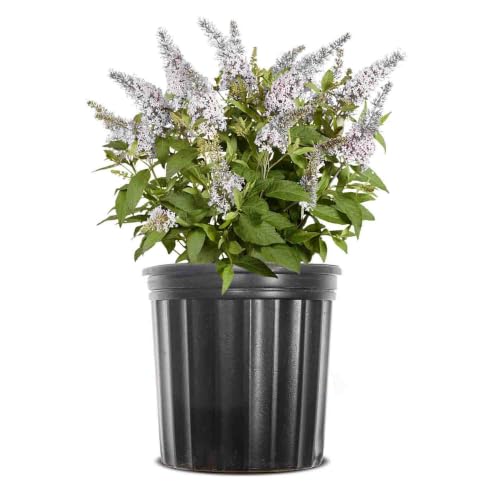
8. Best cold-hardy dwarf with creamy white flowers: Perfect Plants Li’l Coconut Butterfly Bush
Pros
- Very cold-hardy
- Compact and fragrant
- Long blooming season
Cons
- Not available for shipment to California or Arizona.
The Li’l Coconut Butterfly Bush is another compact ‘Butterfly Candy’ variety, growing only 2 to 3 feet tall and wide. It produces clusters of creamy-white, fragrant blooms with soft orange centers that attract pollinators all season. The listing states it is exceptionally cold-hardy, able to withstand temperatures as low as -20°F in zones 5-10.
Best for: Cold climate gardeners who want a compact, fragrant, white-flowering shrub for small spaces.
9. Best dwarf bush for vibrant pink and red blooms: Miss Molly Butterfly Bush Dwarf

Pros
- Vibrant pink-red flower color
- Attracts butterflies and hummingbirds
- Drought-tolerant once established
Cons
- The listing does not specify a mature size or hardiness zones.
The Miss Molly Butterfly Bush is a dwarf Buddleia with vibrant pink and red blooms that appear from mid-summer to frost. It attracts butterflies and hummingbirds and thrives in full sun, becoming drought-tolerant once established. It ships as a well-rooted live plant in a 3-inch pot.
Best for: Adding a burst of pink and red color to a sunny spot in a small garden or container.
10. Best dwarf butterfly bush with large blue flower spikes: Pugster Blue Dwarf Butterfly Bush

Pros
- Large blue flower spikes
- Compact, true dwarf size
- Drought-tolerant and easy to grow
Cons
- The listing does not specify a mature size or hardiness zones.
The Pugster Blue Dwarf Butterfly Bush is a compact shrub known for its large blue flower spikes that bloom from summer through fall. It is a favorite nectar source for butterflies and hummingbirds. The listing describes it as easy to grow, drought-tolerant, and thriving in sunny locations.
Best for: Gardeners wanting the visual impact of large blue flowers on a manageable, low-maintenance plant.
11. Best ultra-compact butterfly bush for very small spaces: Lo & Behold ‘Blue Chip Jr.’ Dwarf Butterfly Bush

Pros
- Very compact mature size
- Suitable for zones 5-9
- Full sun requirement
Cons
- The listing does not mention fragrance or specific pollinators attracted.
The Lo & Behold ‘Blue Chip Jr.’ is a dwarf butterfly bush with a mature size of just 1.5-2.5 feet tall and 1.5-2 feet wide. It produces blue-purple flowers and requires full sun. It is hardy in zones 5-9 and ships as a young plant in a 3-inch pot.
Best for: The smallest gardens, patio pots, or front-of-border planting where space is extremely limited.
12. Best proven winner blue dwarf variety: Pugster Blue® Butterfly Bush – Proven Winners

Pros
- From Proven Winners brand
- Compact size (24-36 inches)
- Blooms summer to fall
Cons
- No shipping to WA or OR.
- The listing does not mention pollinators or fragrance.
This Pugster Blue® Butterfly Bush from Proven Winners is a compact shrub with a mature height of 24-36 inches. It blooms from summer to fall and requires full sun in zones 5-9. The listing notes it does not ship to Washington State or Oregon.
Best for: Gardeners looking for a reputable, compact blue variety from a well-known brand.
13. Best compact bush with unique clear purple and light orange flowers: Proven Winners Pugster Sorbet Butterfly Bush

Pros
- Very compact (1-2 ft)
- Hardy in zones 5-10
- Unique flower color
Cons
- The listing does not mention fragrance or specific pollinators.
The Pugster Sorbet Butterfly Bush grows 1-2 feet tall and wide, making it a very compact option. It is hardy in zones 5-10 and requires full sun. The flowers are described as clear purple with light orange.
Best for: Adding a unique bi-color flower to a compact garden space or container.
Best for starter plants
These options are smaller starter plants, offering a cost-effective way to establish a butterfly bush in your garden.
14. Best red starter plant: Red Butterfly Bush Live Starter Plant

Pros
- Cost-effective starter size
- Well-rooted live plant
- Described as cold-hardy and heat-tolerant
Cons
- The listing does not specify a mature size, hardiness zones, or fragrance.
This is a red butterfly bush sold as a 4-6 inch tall starter plant in a 3-inch nursery pot. The listing describes it as a vigorous, well-rooted live plant that is adaptable, attracts hummingbirds, and is both cold-hardy and heat-tolerant.
Best for: Gardeners willing to start with a small plant and nurture it to maturity.
15. Best bare-root starter for raspberry-pink blooms: Raspberry Butterfly Bush Live Plant

Pros
- Suitable for zones 5-9
- Summer to fall blooms
- Full sun requirement
Cons
- Comes without a pot.
- The listing does not mention mature size, fragrance, or specific pollinators.
This Raspberry Butterfly Bush is a live plant with raspberry-pink blooms, sold at 4-6 inches tall without a pot. It blooms from summer to fall, prefers full sun and well-draining soil, and is suitable for zones 5 to 9.
Best for: Experienced gardeners looking for an bare-root starter plant to establish in their garden.
How to choose a butterfly bush plant
Selecting the right butterfly bush involves more than just picking a pretty flower. To ensure it thrives and becomes a hub for pollinators, you need to match the plant to your garden’s conditions. The most critical factor is your USDA Hardiness Zone, which determines if a plant can survive your winter lows. Always check your zone before purchasing. Next, consider the mature size. Traditional varieties can grow 6-8 feet tall and wide, while newer dwarf cultivars stay under 3 feet, perfect for containers or small borders. Finally, think about sunlight. Butterfly bushes need full sun—typically at least 6-8 hours daily—to produce the best blooms.
What to look for
- Hardiness Zone: This is non-negotiable. A plant rated for zones 5-9 may not survive a zone 4 winter. Verify the plant’s listed zones match your area.
- Mature Size: Ensure you have space for the plant’s full height and width. A ‘compact’ or ‘dwarf’ label is key for small gardens.
- Sun Requirements: Look for listings that specify "full sun." Less sun means fewer flowers and a weaker plant.
- Pollinator Appeal: While most butterfly bushes attract pollinators, listings that mention fragrance, specific nectar sources, or continuous bloom can indicate a particularly good choice.
Remember, a successful pollinator garden is about more than one plant. Consider incorporating native plants alongside your butterfly bush to support a wider range of local bees and butterflies. For more on building a resilient habitat, explore resources from the Xerces Society and the Pollinator Partnership.
FAQ
Are butterfly bushes invasive?
Some traditional Buddleia davidii varieties can be invasive in certain regions because they produce many seeds that spread easily. It’s important to check with your local extension service or a resource like the U.S. Fish & Wildlife Service for regional guidance. Many newer cultivars, especially sterile or seedless varieties, are bred to be less invasive. When in doubt, look for varieties described as "sterile" or "low seed set," though our current listings do not specify this.
How do I care for a newly planted butterfly bush?
Most listings emphasize deep, regular watering for the first two weeks after planting to help roots establish. Once established, these shrubs are generally drought-tolerant. They perform best in well-draining soil and full sun. Pruning in late winter or early spring (cutting back to about 12 inches) encourages vigorous new growth and more flowers, as they bloom on new wood.
Do butterfly bushes need special soil?
Butterfly bushes are adaptable but prefer well-draining soil. They are not particularly fussy about soil pH. For more on how soil affects plant health, see our guide on soil types for pollinator plants. Avoid planting in areas where water tends to pool.
What’s the difference between a dwarf and a regular butterfly bush?
The primary difference is mature size. Dwarf or compact varieties, like the ‘Pugster’ or ‘Li’l’ series, typically stay under 3-4 feet tall and wide, making them suitable for containers and small gardens. Standard varieties can grow 6-10 feet tall and wide. The flower size and pollinator attraction are generally similar, but always check the specific mature dimensions listed for the plant.
References
- Amazon product listings and manufacturer specifications (accessed October 2026)
- USDA Plant Hardiness Zone Map
- Xerces Society for Invertebrate Conservation
- Pollinator Partnership