
 By Emily Parker
Updated November 2026
Choosing among organic lawn fertilizers products can feel harder than it should, because many labels use similar words like “natural,” “slow-release” and “bio-based” without explaining what they actually deliver. This guide compares six widely sold options so you can match a product to your lawn size, your grass type and your goal of keeping the yard safe for pollinators. Our selection method looked at the nutrient analysis printed on each label, whether the product carries recognized organic certification, how it is formulated for release, the packaging size and typical owner feedback patterns. We did not test these products ourselves; the notes below reflect what manufacturers specify and what owners commonly report.
Our top picks at a glance
- 1
 TOP CHOICEBest overallScotts Natural Lawn FoodView on Amazon
- 2
 TOP CHOICEBest for large lawnsDown to Earth Organic Bio-Turf Lawn Food 8-3-5View on Amazon
- 3
 TOP CHOICEBest for deep green colorJonathan Green Organic Lawn Food 10-0-1View on Amazon
- 4
 Best for quick nitrogen boostPurely Organic Products Lawn Food 10-0-2View on Amazon
- 5
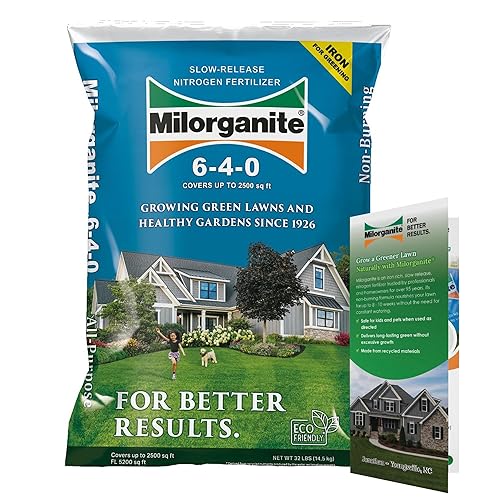 Best for slow-release feedingMilorganite 6-4-0 Fertilizer and Feeding Tips Brochure BundleView on Amazon
- 6
 Best for root and drought resilienceCountryMax Organic Lawn Fertilizer 10-6-4 Slow ReleaseView on Amazon
Our Top Picks
| Product | Best for | Key feature |
|---|---|---|
| Scotts Natural Lawn Food | Most homeowners with mixed grass types | OMRI listed, covers about 4,000 sq. ft. |
| Down to Earth Organic Bio-Turf Lawn Food 8-3-5 | Larger lawns and spreader use | Designed to work with lawn spreaders |
| Jonathan Green Organic Lawn Food 10-0-1 | Owners who want richer color | Contains iron, covers about 5,000 sq. ft. |
| Purely Organic Products Lawn Food 10-0-2 | Smaller yards and spot feeding | 15 lb bag covering about 3,000 sq. ft. |
| Milorganite 6-4-0 Fertilizer Bundle | Slow, steady feeding through the season | Slow-release nitrogen with a feeding guide |
| CountryMax Organic Lawn Fertilizer 10-6-4 | Thinning lawns and stress recovery | Slow-release formula with higher phosphorus and potassium |
Scotts Natural Lawn Food
Scotts Natural Lawn Food, Lawn Fertilizer, For All Grass Types, Apply Any Season, OMRI Listed, Covers 4,000 sq. ft., 29.1 lbs.
Best for: Most homeowners who want one organic product for the whole lawn
This is a good starting point for homeowners with a typical suburban lawn who want a single, widely available organic option. The label states it works on all grass types and can be applied in any season.
Key specs
- Listed as OMRI (Organic Materials Review Institute) approved
- Covers approximately 4,000 sq. ft.
- Package weight 29.1 lbs
Pros
- Organic certification is easy to verify on the label
- Suitable for all grass types, according to the manufacturer
- Large bag size reduces how often you need to reorder
Cons
- Coverage rate means heavier users may need more than one bag per season
- Organic products generally green up more gradually than synthetic options
Bottom line: A sensible default for homeowners who want a certified organic product that covers most of a standard yard.
Down to Earth Organic Bio-Turf Lawn Food 8-3-5
Down to Earth All Natural Fertilizers Organic Bio-Turf Lawn Food for Grass, Landscape and Ornamentals – Works with Lawn Spreaders 8-3-5, 4 lb
Best for: Larger lawns and anyone using a broadcast spreader
This product suits owners with bigger yards who prefer to apply fertilizer with a spreader rather than by hand. The 8-3-5 analysis provides a balance of nitrogen, phosphorus and potassium.
Key specs
- Guaranteed analysis of 8-3-5 (nitrogen, phosphate, potash)
- Package size 4 lb
- Formulated for use with lawn spreaders
Pros
- Balanced nutrient profile covers multiple lawn needs
- Granular form is easy to apply evenly with a spreader
- Works on grass, landscape plants and ornamentals
Cons
- The 4 lb package may be small for large properties
- Requires careful spreader calibration to avoid streaking
Bottom line: Good for owners who want a versatile organic granule for lawns and garden beds in one product.
Jonathan Green Organic Lawn Food 10-0-1
Natural Grass Fertilizer, Contains Iron for Deep-Green Color Jonathan Green Organic Lawn Food – 10-0-1 Grass Fertilizer – 5,000 Sq Ft
Best for: Owners who want deeper green color
This option is aimed at people whose main concern is lawn color. The listing states it contains iron, which is commonly used to deepen green tones without a large surge of top growth.
Key specs
- Analysis of 10-0-1
- Covers approximately 5,000 sq. ft.
- Contains iron
Pros
- Iron content supports a richer green appearance
- Coverage area suits mid-sized lawns
- Nitrogen-forward formula
Cons
- No phosphorus or potassium, so it is not a complete feed on its own
- Owners with poor soil may need a separate amendment
Bottom line: Best for owners who mainly want color and already know their soil has adequate phosphorus and potassium.
Purely Organic Products Lawn Food 10-0-2
Purely Organic Products Lawn Food 10-0-2, 15 LB (Covers 3,000 Square Feet)
Best for: Smaller yards and spot feeding
This 15 lb bag is a practical size for townhouse lawns, front yards and areas that need extra nitrogen between full applications.
Key specs
- Analysis of 10-0-2
- Package weight 15 lb
- Covers approximately 3,000 sq. ft.
Pros
- Manageable bag size for smaller properties
- Nitrogen-rich analysis supports quick green-up
- Easy to store and carry
Cons
- Limited coverage for larger lawns
- Low phosphorus, so soil testing may be advisable
Bottom line: A practical choice for smaller lawns and touch-up feedings.
Milorganite 6-4-0 Fertilizer and Feeding Tips Brochure Bundle
All-purpose slow-release nitrogen for lawns, flowers and gardens; guide covers seasonal timing and spreader settings Milorganite 6-4-0 Fertilizer and Feeding Tips Brochure Bundle, 32lb
Best for: Slow, steady feeding through the season
This bundle is suited to owners who prefer a slow-release approach and want included guidance on timing and spreader settings for lawns, flowers and gardens.
Key specs
- Analysis of 6-4-0
- Package weight 32 lb
- Includes a feeding tips brochure
Pros
- Slow-release nitrogen reduces the risk of surge growth
- Included brochure helps with timing
- Versatile across lawns and ornamental plantings
Cons
- Slower visible response than fast-acting products
- Strong odor some owners mention after application
Bottom line: A good fit for owners who want a long-lasting, low-surge feed and will follow the included timing guidance.
CountryMax Organic Lawn Fertilizer 10-6-4 Slow Release
Improves lawn thickness and color while supporting stronger roots and enhanced resistance to drought and common turf stress CountryMax Organic Lawn Fertilizer 36 lb 10-6-4 Slow Release Formula
Best for: Thinning lawns and stress recovery
This formula is positioned for lawns that need help with density, root development and resilience during dry or stressful periods. Its analysis carries more phosphorus and potassium than most nitrogen-only organics.
Key specs
- Analysis of 10-6-4, slow-release
- Package weight 36 lb
Pros
- Higher phosphorus and potassium support root development
- Slow-release formula supports steady feeding
- Large bag suits bigger properties
Cons
- Phosphorus-heavy analyses are not needed on every lawn; check a soil test first
- Heavier bag can be awkward to lift and carry
Bottom line: Worth considering for owners with thin turf or drought-stressed lawns who want organic root support.
Buying Guide
Check the nutrient analysis (N-P-K)
The three numbers on a bag show the percentage of nitrogen, phosphorus and potassium by weight. A 10-0-2 product is heavy on nitrogen, which drives green leaf growth. A 10-6-4 product adds more phosphorus and potassium for roots and stress tolerance. Match the ratio to what your soil needs, and consider a soil test from your local extension office before choosing.
Good picks for this: CountryMax Organic Lawn Fertilizer 10-6-4 and Down to Earth Organic Bio-Turf Lawn Food 8-3-5
Look for verified organic certification
Organic claims vary. Products listed by the Organic Materials Review Institute (OMRI) have been reviewed against organic input standards. Read the label for the OMRI listing or a clear statement of certification rather than relying on the word “natural” alone.
Good picks for this: Scotts Natural Lawn Food and Milorganite 6-4-0 Fertilizer Bundle
Release speed: fast versus slow-release
Fast-acting organics green up quickly but can push soft growth if overapplied. Slow-release products feed over several weeks and are generally easier to manage in spring and fall. Choose based on how quickly you want visible results and how often you can reapply.
Good picks for this: Milorganite 6-4-0 Fertilizer Bundle and Purely Organic Products Lawn Food 10-0-2
Size the bag to your lawn
Check the coverage rating against your measured lawn area. Measure length times width for each section, add them together, and compare to the bag’s stated coverage. Buying slightly more than you need prevents running short mid-season.
Good picks for this: Scotts Natural Lawn Food for larger lawns and Purely Organic Products Lawn Food 10-0-2 for smaller yards
Spreader compatibility and granule form
Granular products flow more evenly through broadcast and drop spreaders than fine powders. Check whether the manufacturer recommends a particular spreader setting, and run a small test pass on a driveway before covering the lawn to confirm even coverage.
Good picks for this: Down to Earth Organic Bio-Turf Lawn Food 8-3-5 and Milorganite 6-4-0 Fertilizer Bundle
Match the product to your grass and goal
Cool-season and warm-season grasses have different feeding windows. Deep color, density and drought recovery are separate goals, and no single formula excels at all three. Decide your main priority first, then pick the analysis and feature set that serves it.
Good picks for this: Jonathan Green Organic Lawn Food 10-0-1 for color and CountryMax Organic Lawn Fertilizer 10-6-4 for recovery
Storage and handling
Keep bags sealed, dry and off concrete if possible. Moisture can cause clumping and reduce spreading accuracy. Heavier bags are easier to store on a shelf than to carry long distances, so consider your lifting capacity when choosing package size.
Good picks for this: Purely Organic Products Lawn Food 10-0-2 for easier handling and Scotts Natural Lawn Food for bulk storage
FAQ
Are organic lawn fertilizers safe for bees?
Organic fertilizers are generally considered less of a concern for pollinators than many synthetic broadleaf herbicides and insecticides, but no product should be applied directly onto flowers. Keep granules off blooming clover and dandelions, and water in lightly after application so granules settle into the soil.
How often should I apply organic lawn fertilizer?
Most organic products are applied several times per year, often in spring and early fall, with rates and intervals set on each label. Follow the manufacturer’s directions for your product because slow-release and fast-acting formulas differ.
Will organic fertilizer burn my lawn?
Organic products release nutrients more gradually than many synthetic options, which lowers burn risk, but overapplication can still cause problems. Apply at the rate listed and avoid double-passing with the spreader.
Do I need a soil test before buying?
A soil test is the most reliable way to know which nutrients are lacking. Contact your state land-grant university extension office for information on how to submit a sample. Many lawns do not need a high-phosphorus formula.
Can I use organic fertilizer on new sod or seed?
Newly seeded or sodded areas usually need a starter formulation and gentle rates. Check each label for establishment instructions, and avoid heavy nitrogen until the roots are established.
What is the difference between organic and synthetic lawn fertilizer?
Organic fertilizers derive nutrients from plant, animal or mineral sources and typically rely on soil biology to make them available. Synthetic fertilizers provide quickly soluble nutrients. For a side-by-side look, see our guide on Organic vs Synthetic Lawn Fertilizer (2026): Which Is Better for Bees?.
Is a higher number always better?
No. A higher analysis number means more of that nutrient by weight, not better results. The right ratio depends on your soil and grass. Compare products against your lawn’s actual needs.
Conclusion
Among these organic lawn fertilizers products, Scotts Natural Lawn Food is a broad default for most standard yards with its OMRI listing and large coverage. Owners with bigger lawns who use a spreader may prefer the Down to Earth Organic Bio-Turf Lawn Food 8-3-5. For deeper color, the Jonathan Green Organic Lawn Food 10-0-1 is aimed at that goal. Smaller properties and spot treatments suit the Purely Organic Products Lawn Food 10-0-2. Owners who prefer slow, steady feeding may consider the Milorganite 6-4-0 bundle, and those with thin or stressed turf may look at the CountryMax Organic Lawn Fertilizer 10-6-4. A soil test remains the best first step before committing to any single formula. For timing and application, see When to Apply Organic Lawn Fertilizer: A Seasonal Guide for Bee-Safe Lawns and Safe Organic Lawn Fertilizer: A Step-by-Step Guide for Bee-Safe Lawns.
Sources
- Guidance on lawn care practices and fertilizer use around water and wildlife (epa.gov)
- University extension resources on lawn fertilization and soil testing (extension.org)
- Information on organic standards and certification requirements (usda.gov)
Related reading
- 7 Best Purely Organic Products 25 Lb Dry Lawn Food Fertilizers for Bee-Safe Lawns
- 3 Best Purely Organic Products 25 Lb Lawn Food Fertilizers for Bee-Safe Lawns
- Vigoro Organic Lawn Fertilizer: 6 Best Picks Compared for 2026
About Emily Parker
Emily Parker is part of our editorial team and reviews and edits our pollinator-safe lawn care guides, checking product details against manufacturer specifications and owner feedback.



